New Age CBSE CT and AI Curriculum for School Education (2026)
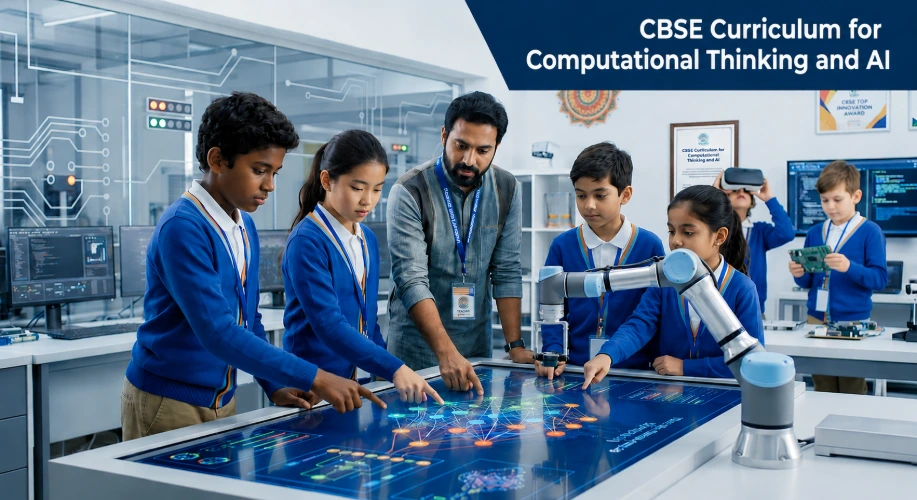
The Central Board of Secondary Education Computational Thinking (CT) and Artificial Intelligence (AI) curriculum for Classes 3–8 represents a major shift in the Indian education system. Designed in accordance with the National Education Policy 2020, the curriculum focuses on preparing students for an AI-driven future by fostering logical thinking, analytical skills, creativity, and ethical understanding from an early stage of learning.
Rather than relying solely on conventional subject-oriented teaching, the curriculum follows a holistic and step-by-step learning model. It first builds a strong foundation in computational thinking and then progressively introduces Artificial Intelligence concepts, enabling students to gain both theoretical knowledge and hands-on experience.
Download the official curriculum PDF →
How CT & AI Helps Students in Real Life:
One of the major strengths of the CBSE CT & AI curriculum is its focus on developing real-world and application-oriented skills.
Decision-Making Ability: Students develop logical and systematic thinking approaches that help them make informed decisions.
Enhanced Mathematical Understanding: Recognizing patterns strengthens analytical and reasoning skills in mathematics.
Improved Communication and Collaboration: Activity-based and project-oriented learning encourages teamwork and effective interaction.
Creativity and Innovation: Learners are motivated to design and build technological solutions rather than simply using technology passively.
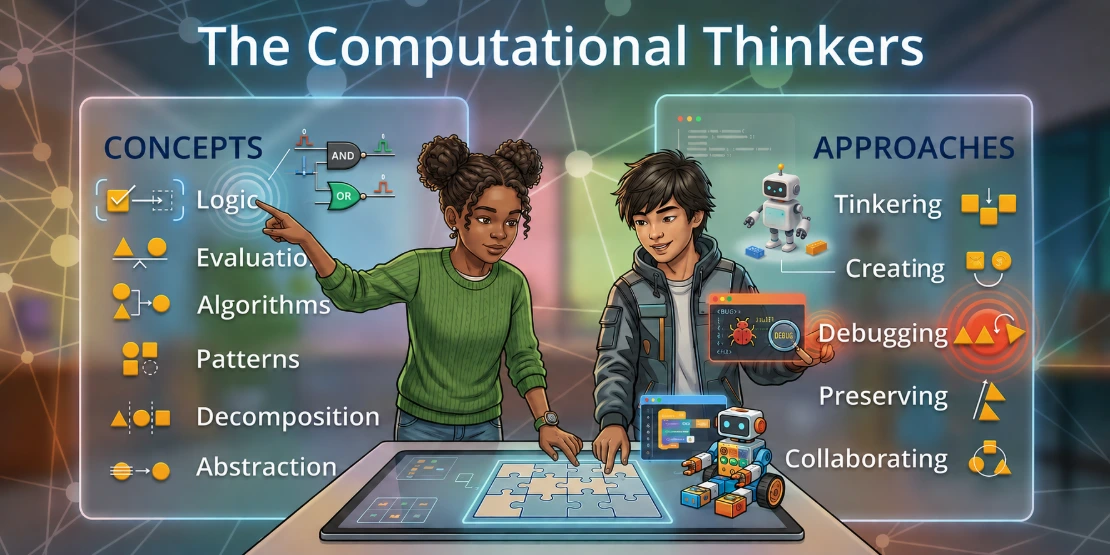
Two important concepts highlighted in the document are:
Computational Thinking (CT):
A systematic method of solving problems by dividing complex challenges into smaller, manageable parts and developing clear, logical, and sequential solutions that can be executed by humans or computers.
Artificial Intelligence (AI):
A field of technology that allows machines to imitate human intelligence by performing functions such as learning, reasoning, decision-making, language understanding, and problem-solving.
Snapshot of the Curriculum Structure
Classes 3–5 (Preparatory Level):
50 instructional hours covering foundational Computational Thinking concepts through Mathematics and TWAU integration.
Classes 6–8 (Middle Level):
100 instructional hours emphasizing advanced CT concepts, AI awareness, and hands-on projects.
Skills and Learning Outcomes:
Primary Level (Grades 3–5)
| Curricular Goal | Focus Areas |
|---|---|
| CG-1: Foundational Problem-Solving Skills | Solve puzzles using visual models; recognize patterns in shapes, symbols, and numbers |
| CG-2: Logical and Analytical Reasoning | Apply systematic thinking for permutations; choose suitable calculation methods; relate ideas across different representations |
| CG-3: Introduction to Computer Fundamentals | Understand computer parts, input/output devices, file handling, internet safety, and block-based programming tools like Scratch |
Middle Level (Grades 6–8)
| Curricular Goal | Focus Areas |
|---|---|
| CG-1: Computational Thinking Skills | Develop decomposition, pattern recognition, abstraction, and algorithmic thinking; understand iteration, symbolic representation, logical operations, arithmetic reasoning, and algorithm efficiency |
| CG-2: Spatial and Visual Reasoning | Visualize, manipulate, and interpret spatial relationships and visual structures |
| CG-3: Foundational AI Understanding | Apply abstraction techniques and demonstrate knowledge of AI tools through hands-on projects |
| CG-4: Ethics in Artificial Intelligence | Identify ethical concerns in AI and apply responsible decision-making principles while using AI technologies |
| CG-5: Digital and Computer Proficiency | Use computers and digital devices for data analysis, visual communication, online research, and infographic creation |
CBSE Official Resources
For Teachers
Download grade-wise Teacher Handbooks directly from CBSE:
For Students
Download grade-wise Student Handbooks directly from CBSE: