
Nvidia’s Physical AI Could Solve Healthcare Robotics’ Data Problem
Artificial intelligence systems usually learn from text, images, videos, and structured data. Healthcare robots, however, face a much more difficult challenge.
A surgical robot must understand how instruments move through the human body, how tissue responds to pressure, how a catheter bends inside a blood vessel, and what happens when a device encounters an unexpected obstruction.
These physical interactions are difficult, expensive, and risky to reproduce using real patients.
Nvidia believes physical AI and advanced medical simulation could help solve this problem.
Its Medical Physics Simulation framework is designed to generate realistic virtual environments in which healthcare robots can practise medical tasks, experience rare complications, and learn physical behaviours before interacting with a patient.
The technology could address one of the biggest barriers in healthcare robotics: the lack of large, diverse, and safe training datasets.
What Is Physical AI?
Physical AI refers to artificial intelligence systems that understand and interact with the physical world.
Traditional AI systems mainly process digital information. A language model learns from text, while a computer vision system learns from images and videos.
A physical AI system must also understand:
Movement
Force
Contact
Resistance
Pressure
Balance
Spatial relationships
Physical consequences
For example, a healthcare robot may need to understand how much pressure it can safely apply to soft tissue. It may also need to recognise when a guidewire has encountered resistance or when a catheter is moving incorrectly through a blood vessel.
These skills cannot be learned through medical textbooks alone.
Healthcare robots need embodied experience—the kind of understanding that comes from interacting with physical environments.
Why Healthcare Robotics Has a Data Shortage
Modern AI systems rely on large amounts of training data. However, healthcare robotics cannot collect data as easily as consumer AI platforms.
Medical procedures are tightly regulated, expensive, and highly sensitive. Patient privacy must be protected, and clinical data must be anonymised before it can be used for research.
Robots also cannot repeatedly practise risky actions on real patients.
Another challenge is that many important medical complications are rare.
A robotic system may need to learn how to respond when:
A guidewire catches on a calcified vessel wall
A kidney stone appears at an unusual angle
A catheter encounters unexpected resistance
Imaging information is incomplete
Sensor readings are delayed
Patient anatomy differs from typical training examples
These situations may not happen frequently enough to produce a large training dataset.
As a result, healthcare robotics companies often struggle to collect enough examples of unusual but clinically important scenarios.
Medical simulation offers a possible solution.
How Nvidia’s Medical Physics Simulation Works
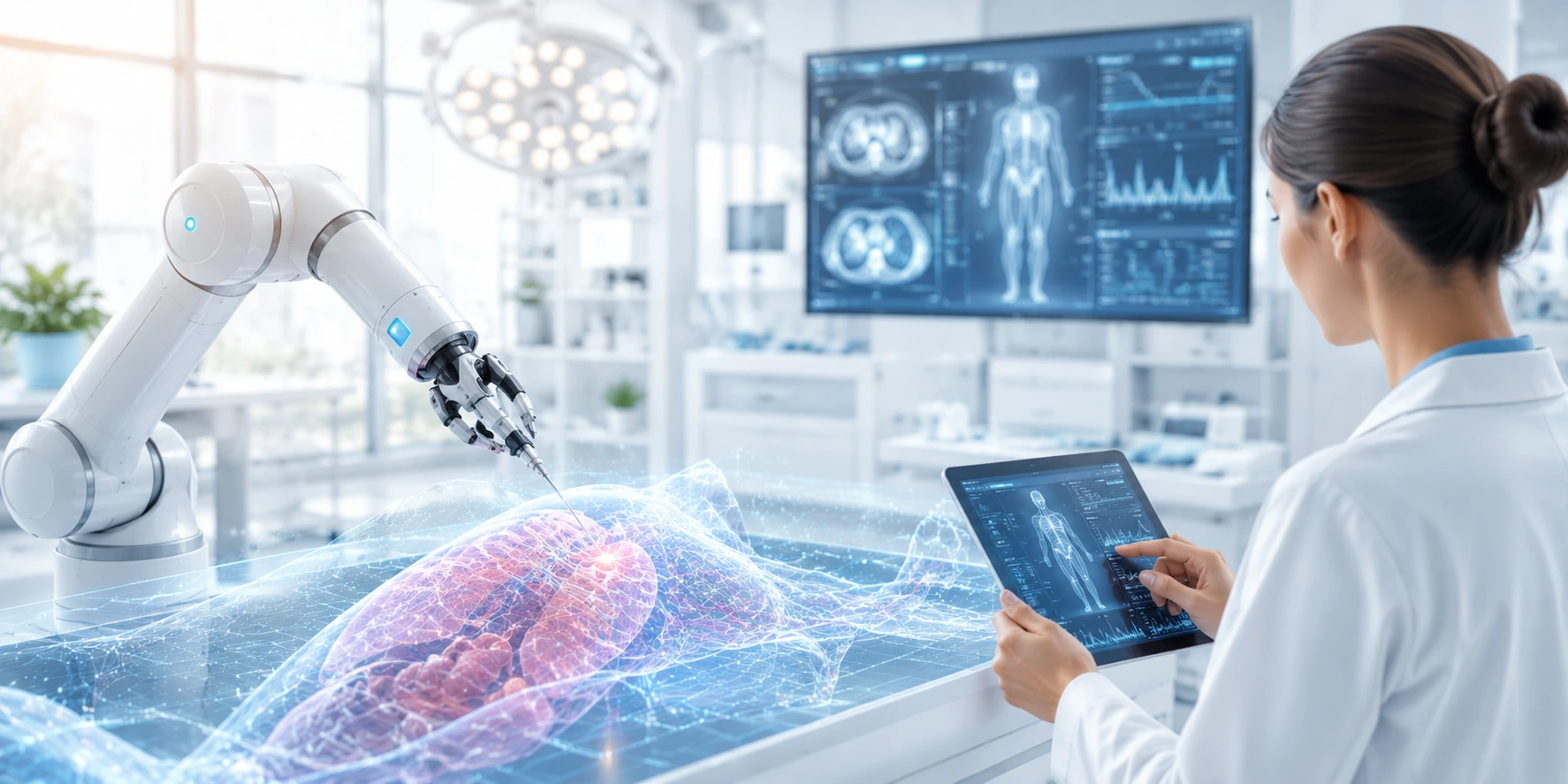
Nvidia’s Medical Physics Simulation framework is an open-source addition to the company’s Isaac for Healthcare platform.
The framework allows developers to create virtual medical environments where robotic systems can practise procedures and learn from repeated interactions.
Instead of waiting for rare complications to occur during real procedures, developers can generate those complications inside a simulation.
A virtual environment could model:
Catheters moving through blood vessels
Surgical tools interacting with soft tissue
Guidewires responding to resistance
Kidney stones appearing in different positions
Robotic devices operating under limited imaging
Patient-specific anatomical variations
These simulations can be repeated thousands of times.
Developers can also change variables such as anatomy, device position, pressure, imaging quality, and sensor input. This helps researchers test whether a robotic system can adapt to unfamiliar conditions.
Combining Physics Simulation With Generative AI
Nvidia’s framework combines classical physics simulation with generative AI.
Classical physics simulation models mechanical behaviours that engineers already understand. This includes how an instrument bends, how tissue responds to pressure, and how contact forces change during movement.
Generative AI helps introduce visual, anatomical, and environmental variation.
Nvidia’s Cosmos-H Dreams technology is designed to generate dynamic medical scenes based on procedural data.
The two approaches serve different purposes.
Classical simulation gives the robot physical rules to follow. Generative AI introduces the variety needed to help the robot generalise across different patients and scenarios.
Together, they can create more realistic and diverse training environments.
Faster Healthcare Robot Training
The framework uses Nvidia’s Warp and Newton libraries to run large numbers of simulation environments in parallel on graphics processing units.
According to Nvidia, one benchmark involving 8,192 parallel environments reduced a training process from more than five hours to under two minutes.
This level of parallelisation could allow developers to:
Test more robotic behaviours
Explore rare failure scenarios
Compare different control strategies
Identify weaknesses earlier
Reduce physical prototyping costs
Speed up medical device research
However, faster training does not automatically guarantee clinical safety.
The benchmark demonstrates computational efficiency, not proven performance inside the human body.
The Simulation-to-Reality Challenge
One of the biggest concerns in medical robotics is the difference between simulation and reality.
A simulation can only represent the conditions included by its developers.
Real medical procedures may involve:
Unexpected patient movement
Unusual anatomy
Incomplete imaging
Delayed sensor data
Device wear
Biological variation
Human error
Conditions not included in the training model
A robot may perform well in thousands of simulated procedures and still behave differently during a real operation.
This difference is known as the simulation-to-reality gap.
The consequences are especially serious in healthcare.
When a chatbot produces an inaccurate answer, the result may be misleading information. When a healthcare robot makes a mistake, it may be physically interacting with a patient.
Simulation should therefore be treated as a development and testing tool—not as a replacement for clinical trials, regulatory approval, human supervision, or real-world validation.
Healthcare Companies Exploring Nvidia Physical AI
Several healthcare and engineering organisations are exploring Nvidia’s physical AI and medical simulation technologies.
CMR Surgical and Cambridge Consultants
CMR Surgical and Cambridge Consultants are using procedural data to study soft-tissue interactions and patient-specific simulations.
CMR Surgical has contributed nearly 500 hours of anonymised clinical data from procedures performed using its Versius Surgical Robotic System.
The data includes procedures such as:
Cholecystectomy
Prostatectomy
Hernia repair
Hysterectomy
This data may help developers create more realistic virtual environments for surgical robot training.
Johnson & Johnson MedTech
Johnson & Johnson MedTech is using the framework to support the development of a digital twin for its MONARCH platform.
The work is focused on kidney-stone scenarios in urology.
A digital twin can help engineers test the behaviour of a medical device in a virtual environment before using it in real procedures.
XCath
XCath is exploring the framework for endovascular autonomy training.
This involves teaching robotic systems how to navigate blood vessels while responding to physical forces and anatomical variation.
Inner Logic
Inner Logic is using synthetic data to validate medical device mechanics.
The company has also discussed the possibility of using in-silico evidence to support regulatory submissions.
Medtronic Structural Heart
Medtronic Structural Heart is exploring simulated X-ray sensing for catheter navigation research.
These projects show growing interest in medical simulation. However, they are primarily research, training, and validation initiatives.
They should not be interpreted as proof that fully autonomous, simulation-trained robots are already operating independently on patients.
Why Open-Source Medical Simulation Matters
Open-source technology could play an important role in healthcare robotics.
Medical AI systems must often be reviewed by engineers, clinicians, regulators, researchers, and safety experts.
An open-source framework allows these groups to inspect:
The physics assumptions used in the simulation
The anatomical models included
The scenarios used for training
The limitations of the framework
The methods used to reproduce results
The way the system responds to unusual conditions
This transparency may make it easier to identify weaknesses and build stronger regulatory evidence.
Open-source code, however, does not guarantee medical accuracy.
Reviewers may be able to examine the model, but they must still confirm that its behaviour reflects what happens inside a real human body.
Transparency supports trust, but clinical validation remains essential.
Digital Twins in Healthcare Robotics
Digital twins are one of the most promising applications of physical AI.
A digital twin is a virtual representation of a physical device, organ, system, or environment.
In healthcare robotics, a digital twin could represent:
A surgical robot
A catheter system
A medical instrument
A patient’s anatomy
A clinical procedure
A medical imaging environment
Engineers could use digital twins to test new device designs before manufacturing physical prototypes.
Doctors may eventually use patient-specific simulations to prepare for complex procedures.
Researchers could also test how robotic systems perform across different anatomical conditions.
However, a visually accurate digital twin is not automatically biologically accurate.
The usefulness of a digital twin depends on the quality of the data, physics models, and validation methods used to create it.
Conclusion
Nvidia is betting that physical AI can help healthcare robots gain the experience they cannot easily obtain from real-world procedures.
Its Medical Physics Simulation framework offers a way to generate rare scenarios, model physical interactions, train robotic systems at scale, and develop digital twins of medical devices and environments.
The technology could accelerate healthcare robotics research and reduce the cost of early-stage experimentation.
However, the central challenge remains: simulated performance must eventually translate into safe, reliable, and clinically proven behaviour.
The future of healthcare robotics should not focus only on creating machines that can perform medical tasks.
It should focus on building trustworthy systems that support healthcare professionals, improve patient outcomes, and protect human safety at every stage.