
Artificial Intelligence (AI) is transforming the way we learn, work, communicate, and solve problems. From voice assistants and recommendation systems to self-driving cars and intelligent robots, AI technologies are becoming an important part of everyday life.
Two terms frequently used in discussions about AI are Machine Learning (ML) and Neural Networks (NNs). Although they are closely related, they are not the same thing.
Machine Learning enables computers to learn patterns from data and make predictions or decisions without being explicitly programmed for every possible situation. Neural Networks are a particular type of Machine Learning model inspired by the way biological neurons process information.
Understanding the difference between these technologies helps us understand how modern AI systems learn, recognise patterns, and make intelligent decisions.
1. What Is Machine Learning?
Machine Learning is a branch of Artificial Intelligence that enables computers to learn from data and improve their performance on specific tasks without requiring a separate set of manually written rules for every situation.
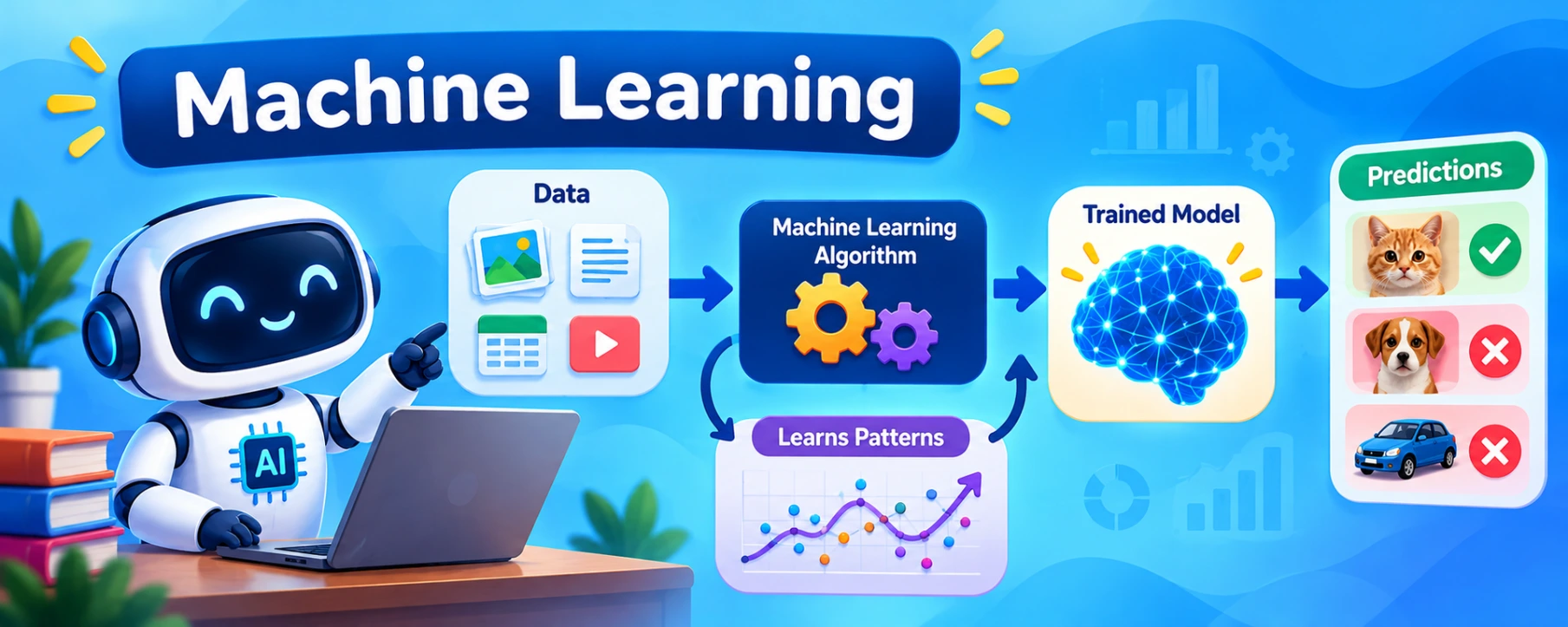
Instead of programming every possible answer, developers provide a Machine Learning system with data and a learning algorithm. The system identifies patterns in that data and uses them to make predictions or decisions about new information.
How Does Machine Learning Work?
Machine Learning generally involves the following steps:
Collect data: Gather relevant information, such as images, text, numbers, or sensor readings.
Prepare the data: Organise the data, correct errors, and make it suitable for learning.
Choose a model: Select an appropriate algorithm based on the problem.
Train the model: Allow the algorithm to identify patterns in the training data.
Evaluate performance: Test the model using data it has not seen during training.
Make predictions: Use the trained model to analyse new information.
Example: An Email Spam Detector
Imagine training a computer to identify spam emails.
The system receives examples of spam and legitimate emails. It learns patterns associated with spam, such as suspicious links, misleading subject lines, or frequently occurring phrases.
When a new email arrives, the trained model analyses its characteristics and predicts whether it is spam.
The important point is that the system learns patterns from examples rather than relying exclusively on a manually written list of rules.
Common Types of Machine Learning
1. Supervised Learning
The model learns from labelled examples, where the correct answer is already known.
Example: Predicting house prices using information about location, size, and number of rooms.
2. Unsupervised Learning
The model identifies patterns or groups in data without being given predefined answer labels.
Example: Grouping customers according to their shopping behaviour.
3. Reinforcement Learning
An agent learns to make decisions by interacting with an environment and receiving rewards or penalties.
Example: Training a robot to navigate an obstacle course.
These approaches are used in different situations depending on the available data and the objective of the task.
2. What Is a Neural Network?
A Neural Network is a type of Machine Learning model inspired by the interconnected structure of neurons in the human brain. It consists of layers of artificial neurons that process information and learn patterns from data.
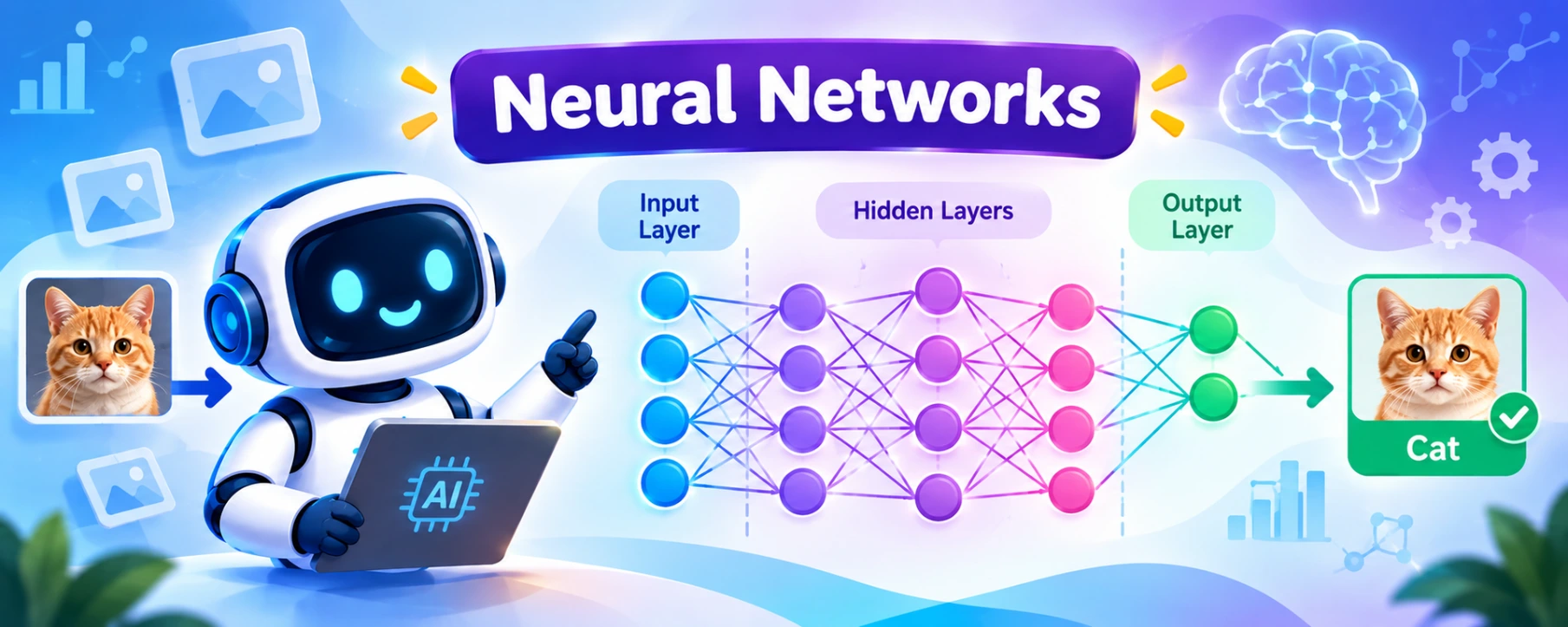
Artificial neurons are mathematical units, not biological brain cells. They receive numerical inputs, apply weights and calculations, and produce outputs that can be passed to other neurons.
Neural Networks are especially useful when working with complex data, including images, audio, natural language, and sensor readings.
How Does a Neural Network Work?
A typical Neural Network contains three main types of layers.
1. Input Layer
The input layer receives the information that the model needs to analyse.
For example, when identifying an object in an image, the input may consist of numerical values representing the image's pixels.
2. Hidden Layers
Hidden layers process the input through interconnected neurons. Each neuron combines inputs using adjustable weights, applies a mathematical function, and passes the result forward.
During training, the network adjusts its weights to reduce prediction errors.
Networks with multiple hidden layers can learn increasingly complex representations of data.
3. Output Layer
The output layer produces the model's result, such as a predicted value, a classification, or a probability associated with a particular category.
Example: Recognising a Cat in an Image
Suppose you want to build a system that can recognise cats in photographs.
During training, a Neural Network receives many labelled images of cats and other objects.
As it learns, different layers may develop representations of features such as edges, textures, shapes, and combinations of visual patterns. The final layers use these representations to help classify the image.
When a new photograph is provided, the network processes the image and generates a prediction about whether it contains a cat.
This ability to learn useful features makes Neural Networks particularly valuable for complex recognition tasks.
3. Machine Learning vs Neural Networks: Key Differences
Although Neural Networks belong to the broader field of Machine Learning, the two terms describe different levels of the technology.
| Feature | Machine Learning | Neural Networks |
|---|---|---|
| Meaning | A broad field of AI techniques that learn from data | A specific family of Machine Learning models |
| Relationship | Includes many different algorithms | A subset of Machine Learning |
| Learning methods | Includes decision trees, regression, clustering, and neural networks | Learns through interconnected mathematical units and adjustable weights |
| Feature extraction | May require manually designed features, depending on the algorithm | Can learn useful features automatically, especially in deep networks |
| Data requirements | Varies by algorithm and task | Complex networks often benefit from large datasets |
| Computing needs | Can range from very low to very high | Can be computationally intensive, particularly for deep networks |
| Interpretability | Some models are relatively easy to explain | Complex networks can be difficult to interpret |
| Typical applications | Fraud detection, forecasting, customer segmentation | Image recognition, speech recognition, language processing |
The key difference: Machine Learning is the broader field, while a Neural Network is one method used within that field.
It is therefore not entirely accurate to treat Machine Learning and Neural Networks as two competing technologies. A more precise comparison is between Neural Networks and other Machine Learning approaches, such as decision trees or linear regression.
4. What Is Deep Learning, and Where Does It Fit In?
Deep Learning is a specialised area of Machine Learning that uses Neural Networks with multiple layers to learn complex patterns and representations from data.
The relationship can be understood through the following hierarchy:
Artificial Intelligence → Machine Learning → Neural Networks → Deep Learning
More precisely, Neural Networks are a model family within Machine Learning, and Deep Learning generally refers to training Neural Networks with multiple layers.
Not every Neural Network is considered deep, and not every Machine Learning model uses a Neural Network.
Example: Identifying Objects in Photographs
Consider three approaches to identifying objects in images:
Traditional Machine Learning: A developer may design image features and use an algorithm such as a Support Vector Machine to classify objects.
Neural Network: A network learns relationships between numerical image features and the correct object labels.
Deep Learning: A network with multiple layers learns complex visual representations directly from image data, often achieving strong performance on challenging recognition tasks.
The most suitable approach depends on the problem, the available data, computing resources, and the required performance.
5. Real-World Applications of Machine Learning and Neural Networks
Both technologies are used across industries. The choice depends on the nature of the task and the complexity of the information involved.
A. Healthcare
Machine Learning models can help analyse patient records, estimate risks, and support clinical decision-making.
Neural Networks can analyse medical images, such as X-rays and MRI scans, to identify patterns that may be relevant to medical professionals.
These systems support healthcare professionals rather than replacing the need for qualified medical judgement.
B. Banking and Finance
Machine Learning is used for fraud detection, credit-risk assessment, demand forecasting, and transaction monitoring.
Neural Networks can identify complex relationships in large volumes of financial data, although simpler models may be preferable when transparency or ease of interpretation is especially important.
C. Education
Machine Learning can help educational platforms identify learning patterns, recommend resources, and estimate which topics students may need to practise.
Neural Networks can support speech recognition, handwriting recognition, language translation, and AI-powered tutoring tools.
For example, an educational application may use AI to analyse a student's response and suggest a suitable learning activity. The quality of the recommendation depends on the model, the data, and how the system is designed.
D. Robotics and Automation
Machine Learning can help robots learn from sensor data, recognise patterns, and improve task-specific decisions.
Neural Networks can support visual object detection, speech-based commands, gesture recognition, and perception in autonomous systems.
Imagine a robot designed to sort objects. Its camera captures an image, a trained Neural Network predicts the type of object, and the robot's control software uses that prediction to determine the next action.
The Neural Network handles the recognition task, while other software and hardware components coordinate the robot's movement.
E. Smart Devices and Everyday Technology
Machine Learning and Neural Networks are used in technologies such as:
Voice assistants that recognise spoken commands.
Recommendation systems that suggest videos, songs, or products.
Smartphones that organise photographs or recognise faces.
Translation applications that process different languages.
Security systems that identify unusual activity.
These applications often combine several AI techniques rather than relying on a single model.
6. Which Is Better: Machine Learning or Neural Networks?
There is no universal winner because Neural Networks are themselves a form of Machine Learning.
The practical question is: Which Machine Learning approach is best suited to a particular problem?
Traditional Machine Learning algorithms can be excellent choices when the dataset is relatively small, the input features are well understood, or the model needs to be easy to interpret.
Neural Networks are often useful when the task involves complex relationships, unstructured data, or patterns that are difficult to represent using manually designed features.
Consider the following examples:
| Problem | Possible approach | Why? |
|---|---|---|
| Predicting house prices from structured data | Linear regression or tree-based models | Often effective for structured numerical information |
| Grouping customers by purchasing behaviour | Clustering algorithms | Helps identify groups without predefined labels |
| Recognising objects in photographs | Convolutional Neural Networks or vision transformers | Designed to learn complex visual patterns |
| Understanding spoken language | Neural Networks and deep learning | Can learn complex relationships in audio and language |
| Detecting suspicious financial transactions | Tree-based models or Neural Networks | The best option depends on data, accuracy, cost, and interpretability requirements |
The right choice should be based on experimentation and evaluation, not simply on which technology sounds more advanced.
How Do Machine Learning Models and Neural Networks Learn?
Both approaches learn by adjusting a model based on data, but their training procedures differ according to the algorithm being used.
In many supervised learning tasks, a model makes a prediction and compares it with the known answer. The difference between the prediction and the correct answer is measured using a loss function.
Training then attempts to minimise that loss.
For example, a model predicting house prices may estimate a house's value and compare it with the actual selling price. The learning algorithm adjusts the model to improve its predictions.
Neural Networks commonly use backpropagation to calculate how network parameters contribute to the error, together with an optimisation algorithm such as gradient descent or one of its variants to update the weights.
This process repeats across training examples until the model reaches a suitable level of performance or meets a stopping condition.
However, not all Machine Learning algorithms use this training process. Decision trees, clustering algorithms, and other methods may learn through entirely different procedures.
Challenges and Limitations
Despite their capabilities, Machine Learning and Neural Networks have important limitations.
Data quality: Incorrect, incomplete, or biased data can produce unreliable results.
Overfitting: A model may memorise patterns in its training data instead of learning relationships that generalise to new examples.
Computational cost: Large Neural Networks can require substantial processing power, memory, electricity, and training time.
Interpretability: Complex models may not provide simple explanations for individual predictions.
Privacy and fairness: Poorly designed systems can expose sensitive information or produce unfair outcomes.
Reliability: Predictions are not guaranteed to be correct, particularly when a model encounters unfamiliar situations or data that differs from its training examples.
Understanding these limitations is essential when building or using AI systems responsibly.
Why Should Students Learn About Machine Learning and Neural Networks?
As AI becomes increasingly important across industries, students benefit from understanding how these technologies work rather than treating AI as a mysterious tool that simply produces answers.
Learning about Machine Learning and Neural Networks can help students develop:
Computational Thinking: Breaking a complex problem into smaller, manageable steps.
Data Literacy: Understanding how data influences predictions and decisions.
Logical Reasoning: Examining patterns, relationships, and possible explanations.
Problem-Solving Skills: Selecting suitable approaches to real-world challenges.
Critical Thinking: Evaluating AI-generated results and recognising potential errors or bias.
Responsible Technology Use: Understanding privacy, fairness, and the limitations of automated decisions.
Students can begin with simple activities, such as creating a rule-based classifier, sorting data into categories, or training an image-recognition model using an educational AI tool.
As their knowledge grows, they can explore how datasets are prepared, how models are trained, and how predictions are evaluated.
Hands-on learning makes abstract AI concepts easier to understand and encourages students to become creators of technology rather than only consumers of it.
Conclusion
Machine Learning and Neural Networks are closely connected technologies that play important roles in modern Artificial Intelligence.
Machine Learning is the broader field that enables computers to learn patterns from data. Neural Networks are a specific type of Machine Learning model that uses interconnected mathematical units to process information and learn complex relationships. Deep Learning extends this approach through Neural Networks with multiple layers.
Neither approach is automatically better in every situation. The most appropriate solution depends on the task, data availability, computing resources, accuracy requirements, and need for explainability.
By understanding these differences, students, educators, and technology enthusiasts can develop a clearer picture of how AI systems work and make more informed decisions when choosing or building intelligent applications.
The future of AI is not just about using intelligent systems. It is also about understanding how they learn, evaluating their limitations, and using them responsibly.